Consignment inventory looks simple on paper. You don’t own the inventory, you sell it, and you share the proceeds. In practice, it’s one of the fastest ways to create financial confusion inside an ERP system if it isn’t handled intentionally.
Many organizations running consignment models in NetSuite start with good intentions, only to find themselves constantly fixing costs, adjusting margins, and explaining discrepancies after the fact.
The issue usually isn’t effort. It’s design.
Why Consignment Is Harder Than It Looks
Consignment inventory introduces a few realities that don’t fit neatly into standard inventory models:
- Ownership doesn’t transfer at receipt
- Costs aren’t final until after sale
- Revenue must be split based on contracts
- Vendor terms vary by agreement
- Settlements often happen later, not at fulfillment
When these rules live outside the system—in spreadsheets, emails, or tribal knowledge—NetSuite can’t enforce them consistently.
Where Native NetSuite Starts to Struggle
NetSuite can technically support consignment, but doing so often requires manual effort and workarounds:
- Custom item setups that are hard to maintain
- Manual cost corrections after fulfillment
- Vendor bills adjusted outside the normal flow
- Revenue recognized before true margin is known
Over time, finance teams spend more time fixing transactions than analyzing them.
The Downstream Impact on Finance
When consignment isn’t modeled correctly, the problems compound:
- Gross margin reports don’t line up
- Inventory valuation becomes unreliable
- Month-end close takes longer
- Audit explanations get complicated
- Trust in the numbers starts to erode
Finance teams end up acting as cleanup crews instead of strategic partners.
Why Manual Fixes Don’t Scale
Many teams accept manual corrections as “just part of consignment.” The problem is that manual fixes don’t scale as volume increases.
As transaction counts grow:
- Errors become harder to spot
- Fixes become inconsistent
- Knowledge becomes siloed
- Risk increases quietly
What worked at low volume becomes fragile at scale.
A Better Way to Model Consignment
EZsuite Consignment was built to bring consignment logic into NetSuite, rather than layering fixes on top of it.
Instead of relying on after-the-fact adjustments, EZsuite Consignment embeds the rules up front:
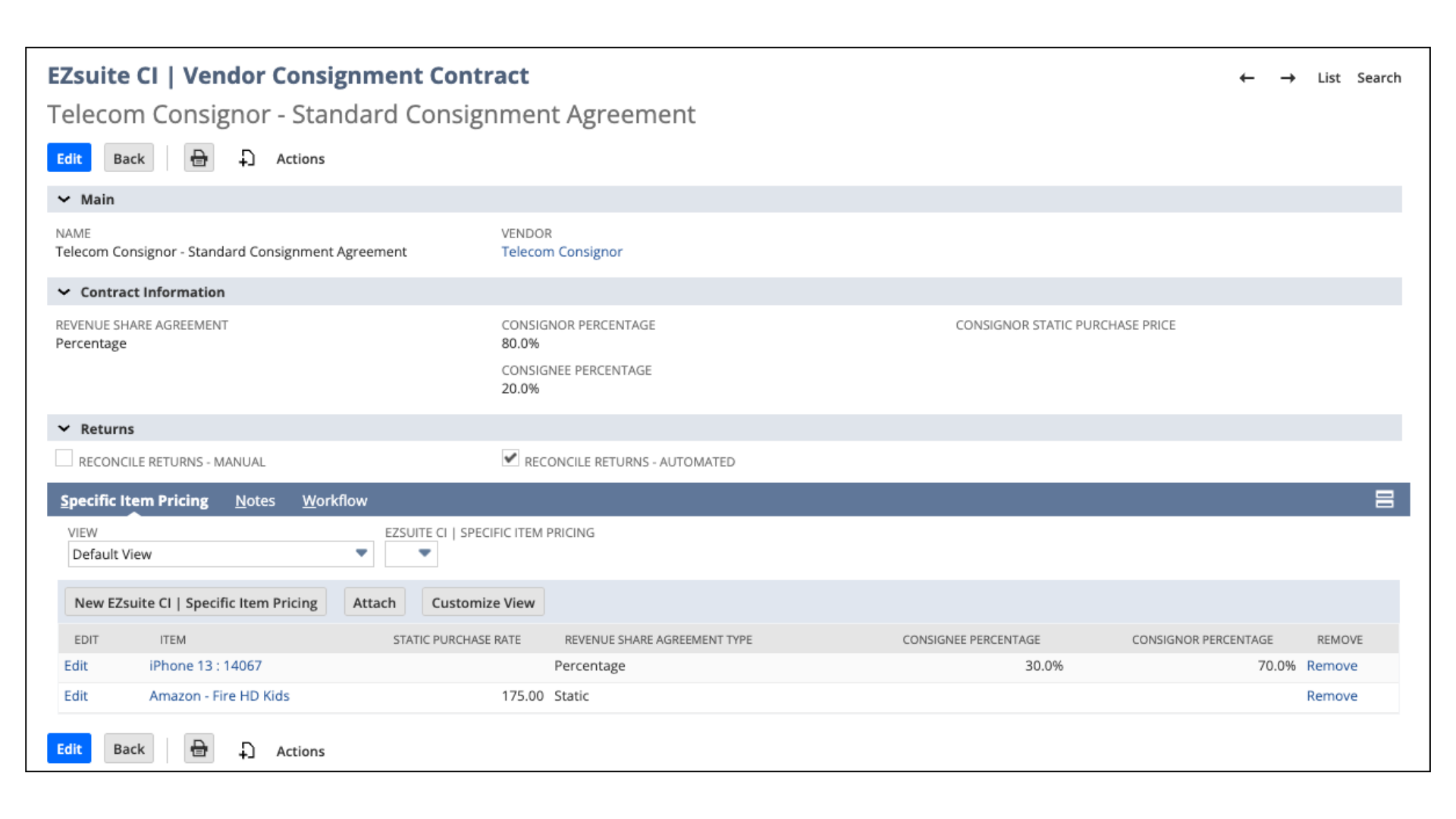
- Vendors, contracts, and pricing are linked automatically
- Purchase orders reflect contract terms
- Costs flow correctly through fulfillment
- Settlements are handled systematically
The system understands the business model instead of guessing at it.
From Sale to Settlement—Without the Guesswork
With EZsuite Consignment in place:
- Items carry consignment context throughout their lifecycle
- Revenue and costs align correctly at sale
- Vendor settlements are calculated accurately
- Financial reporting reflects reality, not estimates
This removes the need for recurring cleanup and reduces friction between finance and operations.
Who This Matters Most For
EZsuite Consignment is especially valuable for organizations with:
- High-volume consignment sales
- Multiple vendors with different rev-share terms
- Complex pricing agreements
- Finance teams tired of constant corrections
If consignment sales are growing, accuracy becomes non-negotiable.
Final Thought: Financial Accuracy Starts With the Right Model
Consignment inventory doesn’t break financial accuracy on its own. It breaks accuracy when the system isn’t designed to handle it.
EZsuite Consignment helps NetSuite reflect the real economics of consignment—so finance teams can trust the numbers and focus on growth instead of fixes.
If consignment still feels messy in NetSuite, it may be time to stop working around the system and start designing it intentionally.